
A missing technical drawing can create serious delays in an engineering project. Production teams may already have the physical component, but without accurate dimensions or CAD files, redesign and manufacturing become difficult. Engineers often spend days measuring complicated parts manually, especially when dealing with curved surfaces, worn components, or custom-made equipment. The process becomes even more complicated when the object has tight tolerances or irregular geometry that cannot be measured properly using standard tools.
This situation usually leads to repeated revisions, inconsistent measurements, and unnecessary production costs. A small dimensional error may affect assembly alignment, machining quality, or product performance. For companies working with industrial machinery, automotive components, or manufacturing systems, inaccurate measurements can interrupt maintenance schedules and reduce operational efficiency.
3D laser scanning reverse engineering helps solve these problems by converting physical objects into accurate digital models quickly and efficiently. Instead of relying on manual measurement methods, engineers can scan an object using high-precision laser technology and generate detailed engineering data for redesign, inspection, or manufacturing purposes. Companies such as Desain Teknik Indonesia provide affordable 3D laser scanning solutions that support fast and accurate non-contact measurements on complex industrial parts.
Contents
show
What Is 3D Laser Scanning Reverse Engineering?
3D laser scanning reverse engineering is a process used to capture the shape and dimensions of a physical object and convert it into a digital 3D model. Engineers use laser scanners to collect millions of measurement points from the object surface. The collected data is then processed into CAD files that can be used for redesign, manufacturing, inspection, or product analysis.
This method is useful when original technical drawings are unavailable, damaged, or outdated. Instead of creating a design from scratch, engineers can scan an existing component and recreate it digitally with high accuracy. The process saves time and helps maintain dimensional consistency during production or maintenance work.
Industries that commonly use this technology include automotive manufacturing, aerospace engineering, heavy equipment, oil and gas, consumer products, and industrial machinery maintenance.
How 3D Laser Scanning Works
The scanning process begins by directing laser lines onto the object surface. Sensors inside the scanner capture the reflected laser data and record the object geometry from multiple angles. The scanner then creates a digital representation called a point cloud, which contains millions of coordinate points describing the object shape.
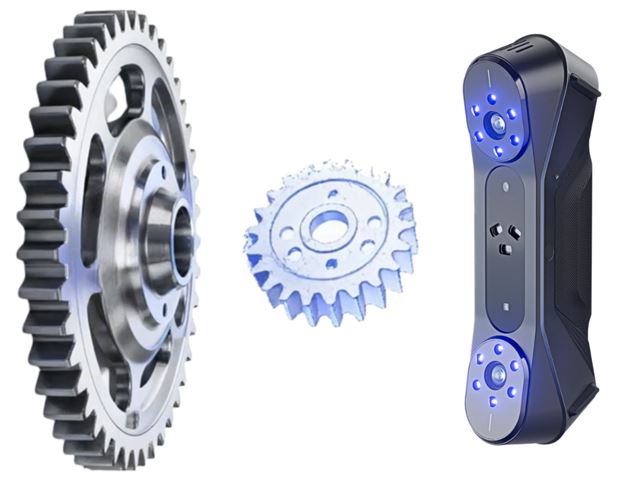
After the scanning process is completed, the point cloud data is converted into mesh models or CAD files using specialized engineering software. Engineers can then modify, analyse, or manufacture the component based on the generated digital model.
Modern scanning systems are designed to work efficiently on complicated surfaces, including metallic components and irregular shapes. Advanced laser technologies improve scanning stability and reduce errors caused by reflective or textured surfaces.
Faster Measurement Process
Traditional measurement methods often require engineers to measure objects manually using callipers, gauges, or coordinate measuring machines. This process takes considerable time, especially for parts with detailed geometry or inaccessible surfaces.
3D laser scanning significantly reduces measurement time because the scanner captures a large amount of dimensional data within seconds. Engineers can complete scanning tasks faster and move directly into CAD reconstruction or design analysis.
This speed becomes valuable during urgent repair projects, product redesign work, or industrial maintenance activities where downtime must be minimised.
Better Accuracy for Complex Parts
Complex components usually contain curves, holes, grooves, and irregular surfaces that are difficult to measure manually. Small measurement errors may lead to assembly issues or machining inaccuracies later in the manufacturing process.
Professional 3D laser scanning systems can achieve precision up to 0.02 mm, allowing engineers to reproduce intricate geometries accurately. This level of precision improves product quality and reduces the risk of dimensional inconsistencies.
Accurate measurement data is also important for simulation, quality inspection, and CNC machining applications.
Non-Contact Measurement Capability
Some industrial components are sensitive, fragile, or difficult to access physically. Contact measurement tools may damage the surface or fail to capture certain geometries properly.
3D laser scanning solves this issue because the process does not require physical contact with the object. Engineers can scan delicate parts safely while maintaining measurement accuracy.
This capability is useful for turbine blades, moulds, historical artefacts, medical devices, and precision-engineered components.
Easier Digital Documentation
Older machines and industrial systems often operate without updated CAD files or engineering documentation. When replacement parts are needed, companies may struggle to recreate the components accurately.
Reverse engineering allows businesses to create digital archives of important equipment and spare parts. The generated CAD files can be stored for future maintenance, redesign, or manufacturing purposes.
Digital documentation also improves long-term asset management and reduces dependency on obsolete technical drawings.
Machine Specifications Used in Professional Scanning Projects
Professional scanning quality depends heavily on the capability of the scanning equipment. Desain Teknik Indonesia offers advanced 3D laser scanning solutions designed for industrial engineering applications.
The machine specifications include:
- Blue Laser and NIR Scanning Technology for accurate scanning on complex metal surfaces
- High-speed scanning up to 660,000 points per second
- Wide object scanning range from 5 mm to 4000 mm
- Full-colour scanning with 24-bit colour support
- High accuracy with precision up to 0.02 mm
These specifications allow engineers to scan small precision components as well as larger industrial equipment efficiently. High-speed data collection also helps shorten project timelines without reducing measurement quality.
Common Applications of 3D Laser Scanning Reverse Engineering
Manufacturers often improve existing products instead of developing entirely new designs. Reverse engineering helps engineers analyse current components and modify them based on updated technical requirements.
By scanning the original product, engineers obtain accurate geometry data that can be adjusted for better performance, lighter weight, or improved manufacturability.
This process shortens development time because the existing product already provides a reliable design foundation.
Spare Part Reproduction
Industrial equipment sometimes uses old or discontinued components that are difficult to replace. Without technical drawings, producing new spare parts manually becomes complicated.
3D laser scanning allows engineers to recreate the component digitally and manufacture it again using CNC machining, casting, or 3D printing methods.
This approach extends machine lifespan and reduces production delays caused by unavailable spare parts.
Quality Inspection and Dimensional Analysis
Manufacturing companies use reverse engineering for quality control and inspection work. Scanned data can be compared directly with original CAD models to identify dimensional deviations or production defects.
This inspection method improves production consistency and helps engineering teams maintain strict manufacturing tolerances.
The process is also faster than traditional manual inspection methods, especially for components with detailed geometry.
Mould and Tooling Development
Industrial moulds and tooling systems require accurate geometry to maintain production quality. Reverse engineering helps engineers replicate worn tools or modify existing moulds efficiently.
The scanned digital model allows engineering teams to analyse wear conditions and improve future tooling designs based on actual production performance.
The Relationship Between Reverse Engineering and Digital Manufacturing
Reverse engineering is closely connected with modern digital manufacturing systems. Once the object is scanned, the generated data can be integrated directly into CAD, CAM, and simulation software for production preparation and engineering analysis.
For readers who want a clearer understanding of the broader concept behind this engineering method, this explanation about what is a reverse engineering provides additional technical insight into how reverse engineering supports manufacturing and product development workflows.
The ability to convert physical objects into digital engineering data helps companies improve communication between design, production, and quality control departments. Accurate digital models also support automation and advanced manufacturing planning.
Important Factors When Choosing a 3D Laser Scanning Service
Choosing the right scanning provider is important because scanning quality affects the accuracy of the final engineering model. Companies should evaluate several factors before selecting a reverse engineering service provider.
Scanning accuracy is one of the most important considerations. The provider should use professional-grade equipment capable of handling complex surfaces and tight tolerances.
Engineering experience is equally important. Skilled engineers understand how to process point cloud data, reconstruct CAD models, and maintain dimensional consistency throughout the project.
Businesses should also ensure the provider can handle different object sizes and material types, including reflective metal surfaces that require specialised scanning technology.
Challenges in 3D Laser Scanning Reverse Engineering
Although the technology is highly effective, some projects still involve technical challenges. Reflective materials, transparent surfaces, and deeply recessed geometries may require additional scanning preparation or multiple capture angles.
Large industrial environments can also create alignment and calibration difficulties during the scanning process. Proper scanning procedures are necessary to maintain consistent measurement accuracy across the entire object.
Another challenge involves processing large amounts of scan data. High-resolution scans generate millions of measurement points, and engineers must clean and organise the data carefully before reconstructing the final CAD model.
Experienced engineering teams usually manage these challenges effectively through proper workflow planning and advanced scanning software.
Why More Companies Are Using 3D Laser Scanning Reverse Engineering
Companies continue investing in reverse engineering technology because it improves efficiency, accuracy, and production flexibility. Faster measurement processes reduce engineering delays, while accurate digital models improve manufacturing reliability.
The technology also helps businesses reduce redesign errors, minimise material waste, and improve maintenance planning for industrial equipment.
As products become more complex, accurate digital reconstruction becomes increasingly important for manufacturing and engineering operations. Businesses that adopt reverse engineering workflows gain better control over product development, spare part management, and industrial maintenance activities.
Companies planning product redesign, spare part reproduction, or industrial inspection projects can benefit greatly from professional 3D laser scanning services. Accurate engineering data creates a stronger foundation for manufacturing efficiency, technical analysis, and long-term operational improvement.
Working with experienced engineering specialists also ensures that scanned data is transformed into reliable, manufacturing-ready models suitable for modern industrial applications.