
A damaged component can interrupt an entire production line, especially when replacement parts are no longer available from the original manufacturer. This situation often creates delays in maintenance schedules, increases operational costs, and forces companies to redesign systems that still function properly except for a single failed part. Engineering teams also face difficulties when technical drawings, CAD files, or manufacturing documentation are incomplete or missing entirely.
The challenge becomes more serious when the component has a complex geometry or requires high dimensional accuracy. Manual measurements may not capture the exact structure needed for reproduction, while traditional drafting methods consume significant time and resources. Without reliable digital data, reproducing the original part accurately can become difficult, particularly for industries that depend on tight tolerances and consistent performance.
This is where reverse engineering becomes highly valuable. Reverse engineering allows engineers to recreate physical components into accurate digital models using advanced scanning and modeling technologies. Through modern 3D laser scanning and CAD reconstruction, companies can reproduce damaged or discontinued parts, improve existing products, and create long-term digital documentation for manufacturing purposes. Engineering service providers such as Desain Teknik Indonesia support this process with precise non-contact measurement technology and professional reverse engineering workflows designed for industrial applications.
Contents
show
What is a Reverse Engineering?
Reverse engineering is a technical process used to analyze an existing object and recreate its design, structure, dimensions, or functionality into digital engineering data. The process commonly involves converting a physical product into a 3D CAD model that can be modified, reproduced, or documented for future use.
Unlike conventional product development that starts from a concept or technical drawing, reverse engineering begins with a finished physical object. Engineers study the geometry, dimensions, materials, and structural characteristics of the component before reconstructing the digital representation.
This method is widely used for damaged machinery components, discontinued spare parts, prototype development, product optimization, and industrial documentation. Reverse engineering also supports quality inspection and manufacturing improvement because engineers can compare scanned data with original CAD specifications.
Why Reverse Engineering is Important in Industrial Applications
Industrial systems often depend on specialized components that are difficult to replace quickly. When manufacturers stop producing certain parts, companies may experience long downtime periods while searching for alternatives. Reverse engineering helps solve this issue by enabling accurate reproduction of existing components without requiring the original technical drawings.
The process is also useful for improving older products. Engineers can analyze legacy equipment, redesign weak areas, and integrate modern manufacturing methods into existing systems. In some cases, reverse engineering allows companies to reduce production costs while maintaining the original functionality of the product.
Another important benefit is digital documentation. Physical parts may deteriorate over time, but digital engineering files can be stored and reused whenever necessary. This creates long-term advantages for maintenance planning and product lifecycle management.
1. Physical Object Inspection
The first stage involves evaluating the condition of the component. Engineers inspect the geometry, material condition, surface complexity, and functional requirements before deciding which scanning and reconstruction methods should be used.
Accurate inspection is essential because damaged surfaces, deformation, or missing sections can affect the reconstruction quality. During this phase, engineers also determine the required tolerance level and intended application of the final CAD model.
2. 3D Laser Scanning
3D laser scanning captures highly accurate measurements from the physical object without direct contact. This technology is especially effective for complex shapes that are difficult to measure manually.
Desain Teknik Indonesia provides affordable 3D laser scanning solutions that deliver fast and accurate non-contact measurements on complex parts. The scanning process generates a dense point cloud that represents the exact geometry of the object.
Because the process is non-contact, sensitive or irregular surfaces can be measured without causing damage. This improves efficiency while maintaining measurement precision.
3. Data Processing and Mesh Generation
After scanning, the collected point cloud data is processed into a polygon mesh. Engineers clean unnecessary data, remove noise, and repair incomplete scan areas before continuing to the CAD reconstruction stage.
The mesh serves as the digital foundation for creating engineering models. Proper data processing ensures that the final CAD output accurately reflects the original component geometry.
4. CAD Reconstruction
Engineers recreate the scanned object into a parametric CAD model that can be edited, manufactured, or analyzed further. This stage transforms raw scan data into usable engineering documentation.
Desain Teknik Indonesia also provides a complete reverse engineering process by recreating objects from 3D scan results. The final reverse engineering data helps customers develop their products and can also function as digital documentation for future engineering requirements.
5. Validation and Manufacturing Preparation
The reconstructed CAD model is verified against the original scan data to ensure dimensional accuracy. Engineers compare tolerances and identify any deviations before preparing the model for manufacturing or product development.
This validation stage is important for industries that require strict dimensional consistency, such as automotive, aerospace, energy, and heavy equipment sectors.
Technologies Used in Reverse Engineering
3D laser scanners are among the most important tools in modern reverse engineering. These systems rapidly capture millions of measurement points from an object’s surface with high accuracy.
Laser scanning technology is particularly useful for large industrial parts, turbine blades, molds, casting products, and irregular geometries. Compared to manual measurement methods, laser scanning significantly reduces inspection time while improving consistency.
Coordinate Measuring Machines (CMM)
CMM systems use probes to measure physical dimensions with extremely high precision. Although slower than laser scanners, CMM equipment is suitable for components that require tight tolerance inspection.
Engineers often combine CMM measurements with laser scanning to achieve both speed and dimensional accuracy in complex projects.
CAD Software
CAD software converts scanned geometry into engineering-ready digital models. These programs allow engineers to reconstruct surfaces, define dimensions, and optimize designs for manufacturing processes.
The resulting CAD files can be used for CNC machining, 3D printing, simulation, quality inspection, or future redesign work.
Common Applications of Reverse Engineering
Industrial equipment frequently experiences wear, corrosion, or structural failure after long operational periods. Reverse engineering allows damaged parts to be reproduced accurately even when original blueprints are unavailable.
This reduces downtime and helps companies maintain older systems without requiring complete equipment replacement.
Recreating Discontinued Parts
Some manufacturers discontinue spare parts for older machinery despite continued market demand. Reverse engineering enables companies to reproduce these components based on the existing physical sample.
This approach is often more cost-effective than redesigning an entire mechanical system.
Product Development and Improvement
Reverse engineering supports product enhancement by helping engineers study competitor products or improve existing designs. The process provides insight into geometry optimization, assembly methods, and manufacturing feasibility.
Digital models generated through reverse engineering can also accelerate prototype development and testing activities.
Digital Documentation
Physical products may not always have proper engineering documentation available. Reverse engineering converts these components into digital CAD archives that can be stored securely for future use.
Digital documentation improves maintenance planning, spare part management, and manufacturing consistency.
Advantages of Using 3D Laser Scanning for Reverse Engineering
Traditional measurement techniques require significant manual effort, especially for complex surfaces. 3D laser scanning captures detailed geometry rapidly, reducing project timelines substantially.
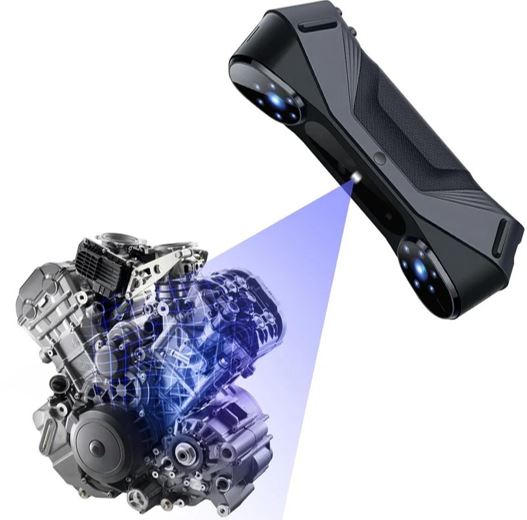
This speed advantage is valuable for industries where equipment downtime directly impacts operational productivity.
High Accuracy on Complex Shapes
Components with curves, cavities, or irregular surfaces are difficult to measure using conventional tools. Laser scanning captures these geometries precisely while maintaining consistent measurement quality.
Accurate scan data improves the reliability of the final CAD reconstruction.
Non-Contact Measurement Capability
Some parts are fragile, large, or sensitive to physical contact. Non-contact laser scanning prevents surface damage while still obtaining precise dimensional information.
This capability is particularly useful for heritage preservation, delicate prototypes, or thin-walled industrial components.
Better Long-Term Documentation
3D scan data creates permanent digital records of physical objects. Companies can store this information for maintenance planning, future manufacturing, or engineering analysis.
Digital archives also simplify future redesign and quality verification activities.
Challenges in Reverse Engineering Projects
Although reverse engineering offers significant benefits, the process still requires technical expertise and proper equipment. Poor scan quality, insufficient resolution, or inaccurate data alignment can affect the final CAD model.
Complex organic surfaces may also require advanced surface reconstruction techniques to maintain accuracy. In addition, damaged or incomplete parts sometimes need engineering interpretation to reconstruct missing sections properly.
Successful reverse engineering projects depend heavily on engineering experience, accurate scanning procedures, and proper CAD reconstruction workflows.
Industries That Frequently Use Reverse Engineering
Factories and industrial facilities often use reverse engineering to reproduce machine components, molds, and tooling systems. This helps reduce maintenance downtime and supports production continuity.
Automotive Sector
Automotive companies use reverse engineering for aftermarket components, restoration projects, and performance improvements. Engineers can recreate unavailable spare parts or optimize vehicle components based on scan data.
Aerospace Industry
Aircraft maintenance operations require extremely precise component inspection and reproduction. Reverse engineering supports dimensional verification, repair analysis, and digital documentation for aerospace applications.
Energy and Oil & Gas
Power plants and energy facilities frequently operate equipment for long periods beyond original production support availability. Reverse engineering helps maintain critical systems by reproducing unavailable components accurately.
Choosing a Professional Reverse Engineering Service
Selecting the right engineering partner is essential for achieving accurate and reliable results. A professional reverse engineering service should provide advanced scanning equipment, experienced CAD engineers, and strong validation procedures.
Companies should also evaluate whether the provider can handle complex industrial geometries and deliver manufacturing-ready CAD data. Fast turnaround time, measurement precision, and technical consultation are equally important considerations.
Desain Teknik Indonesia supports industrial reverse engineering requirements through advanced 3D laser scanning technology and complete CAD reconstruction services. Their engineering team helps businesses reproduce damaged or discontinued components while providing accurate digital documentation for future development needs.
Reliable reverse engineering data can significantly improve maintenance efficiency, product development speed, and manufacturing flexibility. Accurate digital reconstruction also reduces operational risks caused by unavailable spare parts or incomplete technical documentation.
If your company requires precise 3D scanning, CAD reconstruction, or industrial component reproduction, Contact our engineering team to discuss the most suitable reverse engineering solution for your project requirements.