

Precision machining technology and products are becoming the backbone of advanced industrial manufacturing. The expectations placed on engineered components continue to escalate tighter tolerances, higher repeatability, long-term durability, and compatibility with complex designs. When existing tools or traditional processes fall short, the outcome can be costly: delays in production, poor product performance, and inconsistent quality control. Manufacturers working with aerospace, automotive, medical devices, and semiconductor components face strict requirements where a small measurement deviation could lead to full part rejection or safety risks.
Issues emerging during machining processes, such as tool vibration, improper material removal rate, inaccurate measurements, or outdated manual workflows, widen the gap between what is required and what is produced. Teams also face operational disruptions when rework increases, CNC machines are not properly programmed, digital models are not optimised, or inspection equipment lacks precision. As production complexity grows, so does the demand for technologies that enable exactness, automation, and digital integration.
Precision machining offers a structured, reliable approach to solving these challenges. With advanced CNC setup and programming, CAD/CAM integration, and metrology tools such as Coordinate Measuring Machines (CMM), organisations can minimise inconsistencies and optimise repeatable manufacturing. The result is a controlled workflow that supports engineering compliance, stable production output, and long-term product quality.
Contents
show
What Defines Precision Machining Technology?
Precision machining technology involves a combination of digital planning, automated machining processes, and measurement verification systems that ensure every produced part matches the exact specifications of the engineering design. The purpose is to reduce manual error, guarantee dimensional consistency, and enable scalability in production.
This field integrates sophisticated equipment such as CNC machines, laser cutting systems, robotic automation, and inspection tools. The process is driven by engineering principles and data accuracy rather than manual interpretation. Machining tolerances typically operate within microns, enabling components to function properly in demanding applications.
Whether producing prototypes or full-scale mass production parts, precision machining technology ensures predictable output performance through a structured, technology-supported workflow.
CNC Setup and Programming
CNC (Computer Numerical Control) setup and programming is one of the foundational pillars in precision machining. It involves configuring the machine’s coordinate system, tool offsets, cutting parameters, and operational sequences to shape raw materials into precise components. A well-executed CNC program allows automation and consistency in production, minimising operator error and material waste.
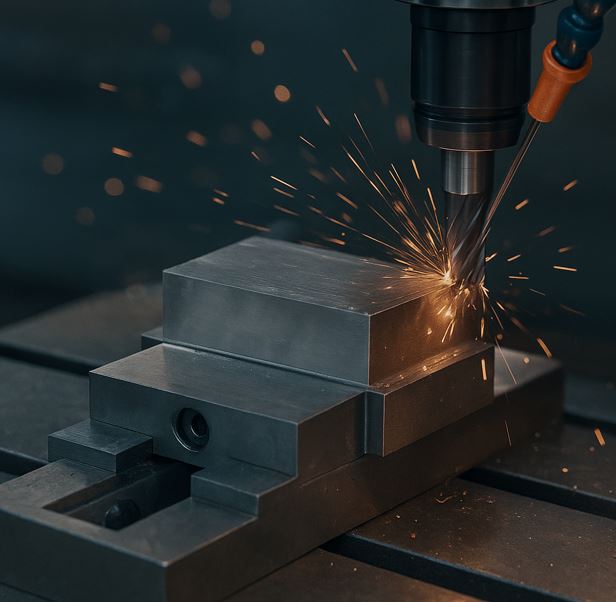
The programming stage includes defining cutting paths, determining machining strategy, and selecting the correct tooling for the material. Complex geometries such as turbine blades, injection mould cavities, and aerospace brackets rely heavily on accurate CNC control. When programmed correctly, CNC machining achieves repeatable results in tight-tolerance applications with stable machine behaviour.
CNC setup also involves calibration and validation procedures to ensure the machine operates within the defined digital design. This includes spindle alignment checks, axis accuracy verification, and testing the machining recipe before full production.
Role of Computer-Aided Design and Manufacturing (CAD/CAM)
CAD/CAM systems bridge the gap between digital product design and physical part production. CAD software allows engineers to model detailed 3D components, define tolerances, assign materials, and evaluate mechanical behaviours. CAM then converts these models into machine-readable toolpaths for CNC execution.
The integration of CAD/CAM streamlines the transition from concept to production. It also ensures the machining process aligns with the original engineering intent. When CAD/CAM workflow is implemented, modifications become more efficient, machining operations can be simulated in advance, and the risk of programming errors is reduced.
Another key benefit is optimisation. Engineers can evaluate alternative cutting strategies, predict machining time, and identify potential collision risks before running the actual equipment. The software also supports machining templates, allowing similar part families to reuse optimised logic, improving production repeatability.
Inspection and Quality Control: Coordinate Measuring Machines (CMM)
Coordinate Measuring Machines (CMM) are essential tools in precision machining environments, especially when tolerances are strict and documentation requirements are regulated. A CMM measures physical parts against digital models using touch probes, optical scanning systems, or laser sensors.
The machine captures data points from surfaces, edges, and contours, generating reports that confirm compliance with the design. CMM systems are highly repeatable and provide statistical accuracy that traditional inspection methods struggle to achieve.
Their role extends beyond inspection; they serve as validation equipment that supports continuous improvement and machining refinement. By analysing dimensional deviations, engineers can identify machine tool drift, setup inconsistency, or CAD interpretation issues. This feedback closes the loop between design, production, and inspection.
Integration of Tooling, Fixtures, and Metrology
Precision machining depends not only on machines and programming but also on stable fixturing and proper tooling. Fixtures hold workpieces securely during machining to reduce vibration and ensure accurate positioning. For example, a well-engineered checking fixture supports measurement consistency, part alignment validation, and production repeatability.
Metrology tools also ensure that the machining environment remains accurate over time. Digital callipers, bore gauges, surface roughness testers, and thermal compensation systems help maintain dimensional integrity throughout the production cycle.
When these elements are harmonised, machining efficiency increases, defect rates decline, and product lifecycle requirements become easier to manage.
Precision Machining Products and Industrial Applications
Precision machining technology supports a variety of engineered products, such as:
- Aerospace structural brackets
- Medical implants and surgical tools
- Automotive drivetrain and engine components
- Semiconductor tooling
- Injection moulds and dies
- Precision gears and mechanical actuators
Each product category demands specific materials, cutting strategies, and quality requirements. Engineers select machining tools and workflows based on material hardness, part geometry, environmental requirements, and operating conditions.
Understanding the relationship between technology and product performance is crucial. Poor machining decisions may reduce fatigue resistance, create thermal deformation, or compromise functionality. When implemented correctly, precision machining enhances efficiency, product longevity, and system reliability.
Digital Workflow and Smart Manufacturing
Precision manufacturing is evolving toward digital workflow integration. CNC machines, CAD/CAM platforms, tool management systems, and inspection equipment are now connected through digital communication standards. The objective is seamless data transfer, reduced errors, and traceable production documentation.
Machine learning and AI-based monitoring systems also help predict tool wear, part deformation, or machining inefficiencies before defects occur. These innovations enable predictive maintenance and reduce downtime.
Why Precision Machining Matters
Precision machining is not a trend; it is a long-term engineering solution. As product designs evolve, tolerances tighten, and customer expectations rise, machining must support complexity, reliability, and repeatability. Precision machining ensures dimensional stability, cost efficiency, and controlled product lifecycle management.
Organisations adopting precision machining technology can meet certification requirements, shorten production cycles, and scale product output confidently.
Ready to Improve Your Manufacturing Accuracy?
If your organisation requires engineered components, fixturing support, precision machining design consultation, or integration with CNC/CAD/CAM workflows, professional engineering assistance can help strengthen your current processes. For technical discussion or project consultation, you may contact our engineering team.