
Manufacturing teams often invest substantial resources in designing and building fixtures intended to improve consistency, positioning accuracy, and production efficiency. However, a fixture that has not been properly validated can introduce dimensional errors, assembly issues, quality defects, and unexpected production delays. These problems may remain unnoticed during initial implementation and only become visible after products fail inspections or customer requirements. The resulting corrective actions frequently consume more time and cost than the original fixture development itself.
The impact becomes more significant when production volumes increase. A small positioning deviation that appears insignificant during prototype stages can multiply into hundreds or thousands of nonconforming parts. Quality engineers, manufacturing managers, and production supervisors may face recurring troubleshooting activities without identifying the actual root cause. This situation can affect delivery schedules, increase scrap rates, and reduce confidence in the manufacturing process.
A structured fixture validation procedure provides a practical solution. By systematically evaluating fixture performance before full-scale deployment, organizations can verify accuracy, repeatability, durability, and process capability. Proper validation creates documented evidence that the fixture performs according to design requirements and supports long-term production objectives. This approach helps minimize risk while improving product quality and operational efficiency.
Contents
show
Fixture Validation Procedure: Definition, Purpose, and Importance
A fixture validation procedure is a systematic process used to verify that a manufacturing, inspection, testing, or assembly fixture performs according to its intended design and functional requirements. The objective is not merely to confirm that the fixture can hold a component, but to ensure that it consistently positions, supports, and locates the part within specified tolerances throughout its operational life.
Validation serves as a bridge between fixture design and production implementation. Before a fixture becomes part of routine operations, engineers need evidence that it can repeatedly deliver the required results under actual working conditions.
The importance of fixture validation extends beyond quality control. It contributes directly to process stability, regulatory compliance, customer satisfaction, and production efficiency. A validated fixture reduces uncertainty and provides confidence that manufacturing outcomes are driven by controlled processes rather than operator-dependent variables.
Key Objectives of Fixture Validation
Every fixture validation activity should be aligned with measurable objectives that support manufacturing requirements. Clear objectives help engineering teams establish appropriate testing methods and acceptance criteria before validation begins.
Typical objectives include:
- Verifying dimensional accuracy
- Confirming repeatable positioning performance
- Evaluating clamping effectiveness
- Ensuring operator usability
- Assessing fixture durability
- Identifying potential failure modes
- Supporting process capability requirements
- Meeting customer and regulatory expectations
When these objectives are clearly defined, validation activities become more structured and meaningful.
Types of Fixtures That Require Validation
Different manufacturing environments use various fixture types, each requiring a tailored validation approach. Although the validation principles remain similar, testing methods and acceptance criteria may differ depending on the fixture’s intended function.
Assembly Fixtures
Assembly fixtures guide components into the correct position during product assembly. Validation focuses on alignment accuracy, assembly repeatability, ergonomic considerations, and cycle-time performance.
The evaluation should confirm that components fit together correctly without introducing stress, distortion, or misalignment that could affect product performance.
Welding Fixtures
Welding fixtures are particularly sensitive because thermal expansion and weld shrinkage can influence final dimensions. Validation activities often include trial welds, dimensional inspections, and repeatability studies.
Engineers must verify that the fixture maintains component positioning throughout the welding process while resisting deformation caused by heat exposure.
Machining Fixtures
Machining fixtures secure workpieces during cutting operations. Validation involves confirming positioning accuracy, clamping rigidity, vibration resistance, and compatibility with machining parameters.
Any fixture movement during machining can directly affect dimensional quality and surface finish requirements.
Inspection Fixtures
Inspection fixtures support measurement and quality verification activities. Their validation ensures measurement consistency and minimizes variability introduced by positioning errors.
These fixtures often require correlation studies with calibrated measurement equipment to verify accuracy.
Planning an Effective Fixture Validation Procedure
A successful fixture validation procedure begins long before testing starts. Proper planning establishes the foundation for reliable results and prevents unnecessary rework during the validation phase.
Engineering teams should first define the purpose of the fixture, expected operating conditions, production volume requirements, and applicable quality standards. These factors influence validation scope and acceptance criteria.
A well-planned validation strategy typically includes documented objectives, testing methods, responsibilities, timelines, and reporting requirements. This structured approach ensures consistency and accountability throughout the project.
Establishing Validation Requirements
Validation requirements should be based on product specifications, manufacturing process needs, customer requirements, and applicable industry standards.
Important considerations include:
- Dimensional tolerances
- Repeatability targets
- Environmental conditions
- Expected fixture lifespan
- Production throughput requirements
- Safety considerations
- Operator interaction requirements
Defining these requirements early reduces ambiguity and helps create meaningful acceptance criteria.
Creating Validation Documentation
Documentation plays a critical role in fixture validation. Without proper records, it becomes difficult to demonstrate compliance or investigate future issues.
Typical validation documents include:
- Validation plans
- Test protocols
- Inspection reports
- Measurement data
- Nonconformance records
- Corrective action reports
- Final validation approval documents
Comprehensive documentation also supports audits and future fixture modifications.
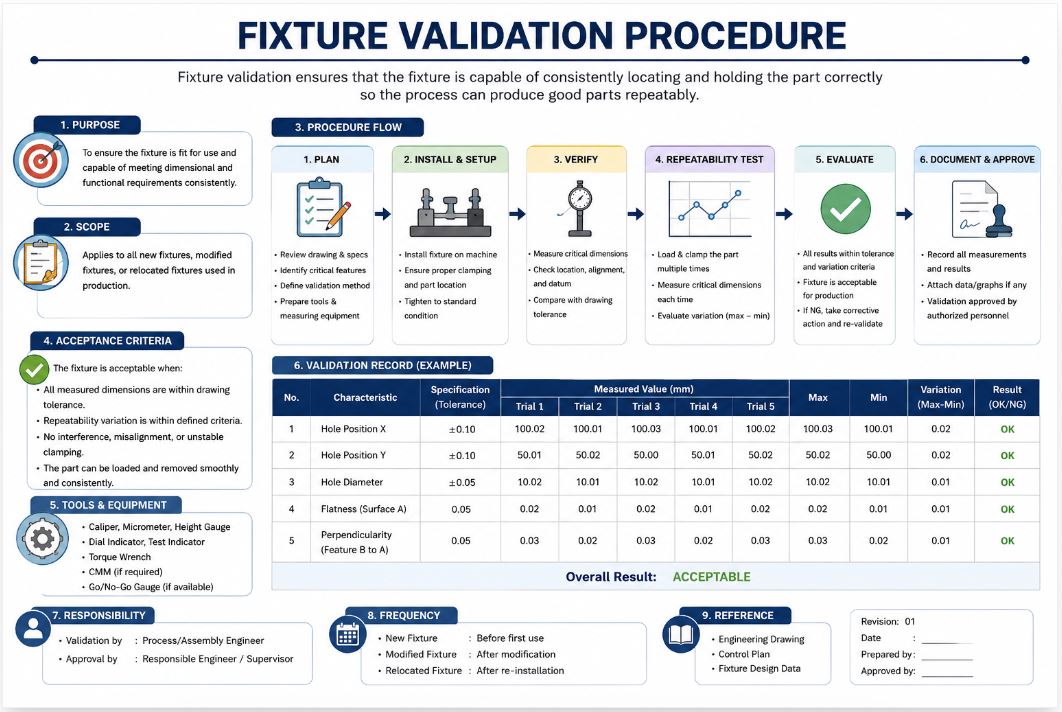
Step-by-Step Fixture Validation Procedure
A structured fixture validation procedure follows a logical sequence designed to verify all critical aspects of fixture performance. Each stage builds upon previous findings to ensure a complete assessment.
Step 1: Design Review and Verification
Before physical testing begins, engineers should review fixture drawings, specifications, and design calculations.
The review should verify:
- Locator positions
- Clamping mechanisms
- Material selections
- Tolerance allocations
- Accessibility requirements
- Safety features
Design verification helps identify potential concerns before resources are spent on extensive testing activities.
Step 2: Visual and Mechanical Inspection
After fabrication, the fixture should undergo a detailed inspection to confirm compliance with design requirements.
Inspection activities may include:
- Dimensional verification
- Surface condition evaluation
- Weld quality inspection
- Hardware verification
- Component identification checks
This stage ensures that the fixture has been manufactured correctly before performance testing begins.
Step 3: Dimensional Accuracy Assessment
Dimensional verification confirms that critical fixture features meet specified tolerances.
Measurement methods may involve:
- Coordinate Measuring Machines (CMM)
- Height gauges
- Dial indicators
- Laser measurement systems
- Precision calipers and micrometers
Results should be compared against approved engineering drawings and acceptance criteria.
Step 4: Repeatability Testing
Repeatability testing evaluates whether the fixture can position the same part consistently over multiple cycles.
The process typically involves:
- Loading the same component repeatedly.
- Measuring critical dimensions after each setup.
- Recording variation data.
- Comparing results against repeatability requirements.
A fixture may appear accurate during a single setup but fail to provide consistent positioning over repeated cycles. Repeatability testing reveals these hidden weaknesses.
Step 5: Functional Performance Testing
Functional testing evaluates how the fixture performs under actual operating conditions.
Depending on the application, this may include:
- Assembly simulations
- Machining operations
- Welding trials
- Inspection activities
- Production cycle evaluations
Testing should replicate real production conditions as closely as possible to obtain meaningful results.
Step 6: Load and Stress Evaluation
Fixtures often experience mechanical loads during operation. Validation should verify structural integrity under expected working conditions.
Engineers may perform:
- Static load testing
- Dynamic load testing
- Fatigue assessments
- Deflection measurements
These evaluations help identify potential durability concerns before production deployment.
Step 7: Operator Assessment
Operator feedback provides valuable insight into fixture usability and practical performance.
Evaluation areas include:
- Ease of loading and unloading
- Accessibility
- Ergonomics
- Safety
- Cycle efficiency
Even technically accurate fixtures can create operational challenges if usability is overlooked.
Step 8: Final Approval and Release
Once all validation requirements have been satisfied, the fixture can be approved for production use.
Final approval typically requires documented evidence showing that:
- All tests were completed successfully
- Acceptance criteria were met
- Nonconformances were resolved
- Required approvals were obtained
This documentation becomes part of the fixture’s permanent quality record.
Critical Parameters Evaluated During Fixture Validation
Several performance parameters influence fixture effectiveness and should be carefully evaluated throughout the validation process.
Accuracy
Accuracy measures how closely fixture positioning aligns with intended design requirements. Poor accuracy can directly affect product dimensions and assembly quality.
Validation data should demonstrate that positioning errors remain within established tolerance limits.
Repeatability
Repeatability reflects the fixture’s ability to produce consistent results under identical conditions.
A fixture with excellent repeatability reduces process variation and supports stable production performance.
Stability
Fixture stability refers to resistance against movement, vibration, or deformation during operation.
Insufficient stability can lead to dimensional variation and process inconsistency.
Durability
Durability assessments evaluate how well the fixture maintains performance over time.
Testing may involve repeated operating cycles to simulate long-term production use and identify wear-related concerns.
Common Challenges in Fixture Validation
Although fixture validation is a well-established practice, several challenges can affect results if not properly managed.
One common issue involves incomplete requirement definitions. When acceptance criteria are unclear, validation teams may struggle to determine whether fixture performance is satisfactory.
Another challenge relates to measurement uncertainty. Inaccurate measurement systems can produce misleading validation data and incorrect conclusions.
Environmental factors such as temperature fluctuations, vibration, and humidity can also influence fixture performance. These conditions should be considered during testing whenever relevant to production operations.
Additionally, organizations occasionally focus exclusively on dimensional verification while neglecting usability and durability assessments. This limited approach may overlook issues that emerge during routine production use.
Best Practices for Improving Fixture Validation Results
Organizations seeking more reliable validation outcomes should adopt standardized practices across engineering and quality functions.
First, involve cross-functional teams early in the process. Design engineers, manufacturing engineers, quality specialists, maintenance personnel, and production operators often identify different risks and improvement opportunities.
Second, establish objective acceptance criteria before testing begins. Clearly defined requirements eliminate ambiguity and improve decision-making.
Third, use calibrated measurement equipment and validated inspection methods. Reliable data forms the foundation of meaningful validation conclusions.
Fourth, perform validation under conditions that closely represent actual production environments. Laboratory results may not accurately reflect real-world performance if operating conditions differ significantly.
Finally, maintain detailed validation records. Thorough documentation supports traceability, facilitates audits, and provides valuable reference information for future fixture upgrades or redesign projects.
Integrating Fixture Validation Into Continuous Improvement Programs
Fixture validation should not be viewed as a one-time activity performed only during initial implementation. Production environments evolve, products change, and process requirements become more demanding over time.
Organizations that integrate fixture validation into continuous improvement initiatives gain better visibility into long-term fixture performance. Periodic reviews, capability studies, maintenance inspections, and performance audits help identify gradual degradation before quality issues emerge.
A proactive approach also supports predictive maintenance strategies. Rather than waiting for fixture failures to affect production, teams can monitor key indicators and implement corrective actions at the appropriate time.
If your organization relies on fixtures for assembly, machining, welding, inspection, or testing operations, establishing a formal fixture validation procedure can significantly reduce process risk while improving product quality. Evaluate existing validation practices, identify potential gaps, and develop standardized methods that align with operational requirements. A well-executed validation program not only protects quality performance but also strengthens efficiency, consistency, and customer confidence across the entire manufacturing process.