

Bringing a new product to market often starts with excitement and strong conviction. However, once the initial concept is translated into something tangible, uncertainty begins to surface. A design that looks perfect on screen may fail under real-world stress. A sample unit that works in a lab environment may become costly, inconsistent, or impossible to assemble at scale. The gap between “it works” and “it can be manufactured reliably” is wider than most teams expect.
This gap frequently leads to delays, cost overruns, tooling rework, and strained supplier relationships. Decisions made during early design stages can silently lock a product into inefficient manufacturing paths. Materials chosen for convenience during early testing may not be viable for mass production. Tolerances that seem acceptable in a single unit may cause unacceptable defect rates when repeated thousands of times. Without clarity on the difference between a prototype and a production unit, projects risk stalling just before market launch.
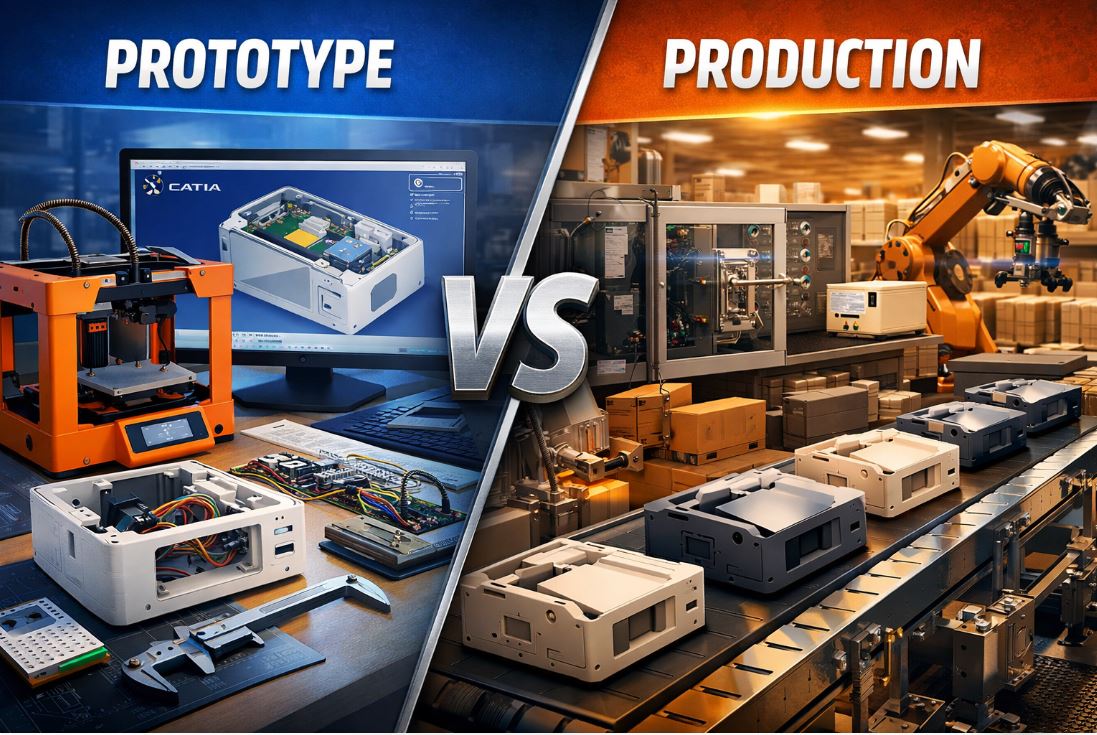
Understanding the distinction between prototype and production is not just a technical detail; it is a strategic necessity. When teams clearly separate validation objectives from manufacturing objectives, they can design smarter, reduce risk, and accelerate commercialization. This article explains the real difference between prototype and production, how each stage serves a distinct purpose, and how to transition from one to the other with confidence.
Contents
show
What Is a Prototype?
A prototype is an early version of a product built to test form, function, usability, or technical feasibility. Its primary objective is learning, not scaling. Engineers use prototypes to validate assumptions, identify design flaws, and gather feedback before committing to tooling or large production investments.
In most development cycles, prototypes evolve through several iterations. Early versions may focus purely on physical appearance (form prototypes), while later ones prioritize mechanical or electronic functionality. Some prototypes combine both, depending on the stage of development.
Types of Prototypes
Different prototype categories serve specific validation goals. Selecting the correct type helps teams avoid unnecessary cost and confusion.
1. Concept Prototype
A concept prototype demonstrates general shape, size, and visual appearance. It may be 3D printed, CNC machined, or even handcrafted. These units are typically used for stakeholder presentations, ergonomic checks, or early investor discussions.
2. Functional Prototype
A functional prototype validates whether the product performs as intended. Internal components are tested under controlled conditions. Engineers measure stress points, thermal behavior, electronic performance, and mechanical reliability.
3. Engineering Prototype (EVT/DVT Stage)
Engineering Validation Test (EVT) and Design Validation Test (DVT) prototypes are closer to final specifications. They are built using near-final materials and components. At this stage, teams begin preparing for manufacturing by refining tolerances, assembly processes, and supplier coordination.
Each prototype type answers different technical questions. What matters is that the prototype stage is fundamentally about verification and improvement, not mass output.
What Is Production?
Production refers to the process of manufacturing a product at scale, consistently and efficiently, according to finalized specifications. Unlike prototypes, production units must meet strict standards for quality control, repeatability, cost optimization, and regulatory compliance.
The transition from prototype to production requires more than simply repeating the same build process. Production introduces constraints that prototypes do not face, including:
- Tooling investments
- Assembly line efficiency
- Supply chain reliability
- Cost targets
- Certification requirements
- Packaging and logistics considerations
A design that performs well as a single prototype may fail under the pressure of high-volume manufacturing if it has not been optimized for production conditions.
Prototype vs Production: Core Differences
Understanding the structural differences between these two stages prevents expensive redesign cycles later. Below is a breakdown of the most critical distinctions.
1. Purpose and Objective
Prototypes exist to validate ideas and reduce technical uncertainty. They answer questions such as:
- Does it work?
- Is the design feasible?
- Does the user interface make sense?
Production units exist to deliver consistent quality at scale. They answer different questions:
- Can it be manufactured repeatedly without defects?
- Does it meet cost targets?
- Is the process stable and efficient?
Confusing these objectives often leads to premature tooling investment or, conversely, endless prototyping without market entry.
2. Materials and Manufacturing Methods
Prototype units frequently use flexible and quick-turn processes such as:
- 3D printing
- CNC machining
- Manual assembly
- Soft tooling
These methods prioritize speed and iteration flexibility.
Production, however, relies on scalable methods such as:
- Injection molding
- Die casting
- Automated assembly lines
- Progressive stamping
Production tooling is engineered for durability and repeatability. For example, injection molds may be built to withstand hundreds of thousands of cycles. This is where detailed 3D Mold Design becomes essential, ensuring that part geometry, cooling channels, gate locations, and ejection systems support consistent output without warping or shrinkage defects.
3. Cost Structure
Prototype cost per unit is typically high because the focus is on validation rather than efficiency. A single prototype may cost significantly more than a production unit.
Production requires cost optimization at multiple levels:
- Raw material sourcing
- Cycle time reduction
- Labor efficiency
- Packaging optimization
- Waste minimization
Design decisions during prototyping heavily influence production cost later. Wall thickness, part consolidation, and fastener selection all contribute to long-term cost structure.
4. Tolerances and Quality Control
During prototyping, tolerances are often relaxed. Minor dimensional variations may be acceptable as long as functionality is preserved.
In production, tolerances must be clearly defined and measurable. Statistical Process Control (SPC), inspection standards, and quality documentation become mandatory. Consistency matters more than individual performance.
5. Documentation and Compliance
Prototype documentation is typically limited to design files, internal reports, and test results.
Production requires comprehensive documentation, including:
- Bill of Materials (BOM)
- Assembly instructions
- Quality inspection plans
- Regulatory certifications
- Supplier agreements
Without this structure, scaling becomes chaotic and error-prone.
The Critical Transition: From Prototype to Production
The most challenging stage in product commercialization is the transition phase. This is where many projects stall due to underestimated complexity.
Moving from a validated prototype to scalable manufacturing requires alignment between engineering design and manufacturing capability. This process is often managed under structured Product Development frameworks, where cross-functional teams collaborate to ensure design intent matches production reality.
Several key activities occur during this phase:
- Design for Manufacturing (DFM) review
- Design for Assembly (DFA) optimization
- Tooling design and fabrication
- Pilot production runs
- Process validation
Skipping these steps may result in tooling rework, unstable yield rates, or delayed market launch.
Design for Manufacturing (DFM): The Bridge Between Stages
Design for Manufacturing ensures that a product can be produced efficiently and reliably before full-scale production begins.
Engineers analyze:
- Wall thickness consistency
- Draft angles for molded parts
- Undercut complexity
- Part consolidation opportunities
- Assembly sequence simplification
For molded components, close collaboration with tooling specialists is necessary. Advanced 3D mold design helps simulate material flow, cooling efficiency, and potential defect zones. These simulations reduce the risk of sink marks, voids, or warpage during production.
DFM is not about compromising design; it is about refining it so that manufacturing constraints are integrated into the product architecture.
Common Mistakes When Confusing Prototype and Production
Several recurring issues appear when teams fail to distinguish between these stages.
Over-Investing Too Early
Committing to hardened tooling before validating design functionality often results in expensive modifications.
Under-Preparing for Production
Assuming that a working prototype automatically qualifies for mass manufacturing leads to unstable quality and cost escalation.
Ignoring Supplier Input
Production scalability depends heavily on supplier capabilities. Early collaboration reduces later friction.
Inadequate Testing
Prototype testing should simulate real-world conditions as closely as possible. If validation is incomplete, production risks increase.
When Is a Prototype Ready for Production?
There is no universal checklist, but several indicators suggest readiness:
- Functional performance meets target specifications
- Regulatory requirements are identified and addressed
- Materials are confirmed for supply stability
- Manufacturing process capability has been evaluated
- Cost analysis aligns with market expectations
Pilot runs are often conducted to test the stability of the production process before full ramp-up.
Strategic Perspective: Why the Distinction Matters
From a business standpoint, the prototype stage manages technical risk, while the production stage manages commercial risk.
Technical risk involves feasibility, reliability, and usability.
Commercial risk involves cost competitiveness, delivery timelines, and supply chain resilience.
Separating these risk categories allows decision-makers to allocate budget and resources more effectively. It also improves communication between engineering, procurement, and operations teams.
A Practical Example
Consider a plastic enclosure designed for industrial equipment. The prototype may be 3D printed for quick validation. It fits the internal PCB and passes basic functional tests.
However, during production planning, new questions arise:
- Can the wall thickness support injection molding without sink marks?
- Are draft angles sufficient for mold release?
- Is the snap-fit design durable after repeated assembly cycles?
- Can assembly be automated?
Addressing these questions early prevents expensive mold rework later. This is precisely why structured product development processes integrate engineering validation with manufacturing planning rather than treating them as separate efforts.
Aligning Engineering Vision with Manufacturing Reality
Successful commercialization requires clear stage separation, disciplined validation, and early manufacturing involvement. Prototype development should encourage experimentation and iteration. Production preparation should enforce discipline, repeatability, and cost awareness.
If your organization is developing a new product and approaching the transition phase, it is essential to conduct a structured DFM review and tooling feasibility study before committing to full-scale manufacturing.
Engage your engineering and manufacturing partners early. Evaluate material choices, optimize part geometry, and validate assembly processes under realistic conditions. A well-managed transition reduces delays and protects your investment.
When the difference between prototype and production is understood and respected, product launch becomes a controlled progression rather than a reactive correction process. Careful planning, thorough validation, and manufacturing integration are what ultimately transform a promising idea into a scalable, market-ready product.
If you are currently refining a prototype and preparing for scale-up, now is the time to assess whether your design truly meets production standards. A focused review today can prevent months of correction tomorrow.